EmDash vs WordPress in 2026: what actually matters
A practical look at what EmDash changes, where WordPress still wins, and how to think about migration, security, AI, and the CMS stack in 2026.
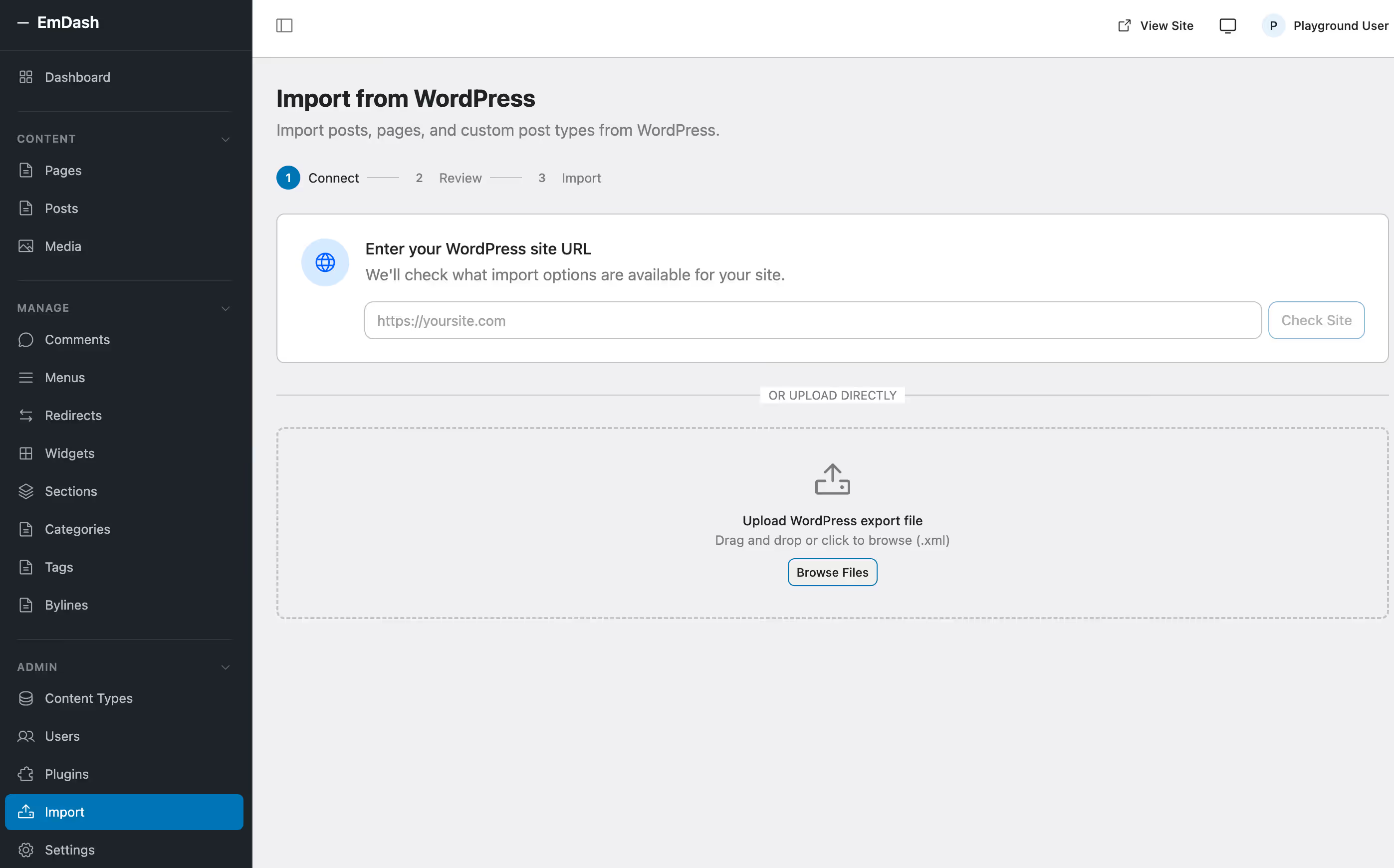
One topic has cut through the CMS conversation this year more sharply than most launch announcements ever do: EmDash.
That reaction makes sense. Cloudflare did not release a minor utility or another developer toy. It introduced an open-source CMS with a deliberately provocative premise, a modern platform that takes direct aim at assumptions WordPress has carried for years. That alone was always going to trigger strong reactions. Some people rushed to call it the future. Others dismissed it as hype. Quite a few treated it as if WordPress had suddenly become obsolete overnight.
I think both extremes miss the point.
As the owner of WPPoland.com and co-organiser of CMSConf.com, I spend a lot of time looking at what is stable in the CMS market and what is changing underneath it. From that angle, EmDash matters a great deal. Not because it is already ready to replace WordPress for most production projects, it is not, but because it makes a serious architectural argument about what the next generation of CMS platforms should look like.
That is why this comparison matters.
Not another “WordPress killer”
The phrase “WordPress killer” is usually a sign that a conversation is becoming less useful.
We have seen this pattern for years. A new platform appears, usually with cleaner code, a more fashionable stack, or a more focused product story. Then the market conversation jumps immediately to a false binary, either the newcomer destroys WordPress, or WordPress crushes the newcomer and nothing changes. Real life is never that neat.
WordPress still powers a huge share of the web. More importantly, it is not just software. It is an ecosystem, a labour market, a commercial network, a publishing habit, and in many organisations a default operating model. That kind of installed reality does not disappear because a technically more elegant product shows up.
At the same time, technical elegance does matter. Architecture matters. Direction matters. And this is exactly where EmDash becomes interesting. It is not merely saying “here is a CMS built with newer tools”. It is saying that some of the old trade-offs around security, structured content, deployment, and AI integration no longer need to be accepted.
That is a much more important conversation than whether WordPress dies next year, because it points to where the whole category is moving.
Why EmDash carries more weight than a normal launch
If EmDash had come from a small startup, people would still have noticed it, but the stakes would be lower.
Cloudflare changes that immediately.
Cloudflare already controls major parts of the infrastructure stack that modern web products rely on, CDN, DNS, edge compute, storage, performance, security and traffic handling. So when Cloudflare launches a CMS, it is not inventing a product in isolation. It is integrating content management with an infrastructure worldview it already owns deeply.
That matters because CMS decisions are no longer just editorial decisions. They are also deployment decisions, performance decisions, security decisions, and increasingly AI workflow decisions. A platform built with edge execution, object storage, typed schemas, and modern API assumptions from the beginning can sidestep many of the compromises older systems have had to carry.
In practical terms, EmDash is built around TypeScript, Astro, Cloudflare Workers, D1, and R2. That means it begins from very different assumptions than WordPress. There is no traditional PHP request lifecycle at the centre of the system. There is no default dependence on the classic LAMP model. There is no long legacy of file-based assumptions dragging modern decisions backwards.
For developers, that feels significant immediately. For agencies, it may feel less dramatic at first. But even agencies that do not intend to touch EmDash should pay attention, because the architectural ideas behind it are not niche anymore. They are becoming increasingly normal across modern web delivery.
Where EmDash is genuinely ahead
This is the part that WordPress professionals should not avoid.
EmDash does some things better, not in marketing language, but in underlying architectural logic.
Plugin security is the strongest argument
The biggest point in EmDash’s favour is its approach to extensibility.
WordPress plugins are one of the reasons the platform became so dominant. They are also one of the reasons WordPress security remains such a persistent operational problem. A plugin can dramatically extend a site, but the trade-off is that plugins often operate with broad privileges. In real projects, that means every plugin choice is also a trust decision, and not all trust decisions are good ones.
Anyone who has maintained WordPress sites at scale knows this pain well. Vulnerable plugins, abandoned plugins, plugins with weak coding practices, plugins that conflict with each other, plugins that expose data, plugins that quietly become the weakest link in an otherwise well-maintained system. This is not a fringe issue. It is one of the platform’s most familiar structural weaknesses.
EmDash takes a different route. Its plugin model is designed around sandboxing and explicit permissions. Put simply, the system is trying to reduce the assumption that an extension should be allowed to do almost anything by default. That is a serious improvement in philosophy. If it holds up in practice, it could become one of the most influential ideas to come out of a CMS launch in years.
Even if EmDash itself never becomes dominant, this one idea puts pressure on the rest of the market. It asks a very uncomfortable but necessary question: why should extensibility still mean broad implicit trust in 2026?
Structured content is a better fit for modern consumption
WordPress still does a lot of work with content stored and represented in ways that grew out of a page-centric, HTML-first web. That made sense for a long time. For classic publishing, it still often works well enough. But content is no longer consumed in one place, through one rendering path, for one interface.
Now content moves across websites, APIs, automation systems, internal tools, apps, search surfaces, and AI interfaces. In that context, strongly structured content becomes much more valuable than content that is easy to render but harder to analyse, validate, or repurpose cleanly.
EmDash leans into structure from the beginning. That improves machine readability, content portability, and future flexibility. It also makes the platform easier to align with headless patterns and agent-based workflows. For teams that think beyond a single website front end, that architectural choice is not cosmetic. It is strategic.
WordPress can, of course, support structured approaches. But too often it reaches them through plugins, conventions, or workarounds. EmDash starts there.
AI readiness is not a side feature
The AI angle is where a lot of CMS conversations become shallow very quickly. Adding a button that generates a draft is not the same thing as being architected for AI-native workflows.
EmDash is interesting here because its design language suggests AI integration is part of the model, not a decorative add-on. Typed schemas, MCP support, machine-readable structures, and cleaner developer pathways all make it easier for content systems to interact with tools beyond the browser-based editor.
WordPress can absolutely participate in this world, and many teams are already building impressive AI-assisted workflows on top of it. Still, WordPress usually gets there through layers, plugins, APIs, custom glue, and selective modernisation. EmDash has fewer legacy assumptions to fight.
That matters because the next generation of CMS value may not be defined only by what editors do manually inside an admin panel. It may be defined by how reliably content can move between humans, systems, automations, and AI agents without turning into chaos.
The deployment model feels current
For many developers, this part may be the easiest to appreciate instantly.
EmDash is aligned with the way modern frontend and platform teams already think. Serverless execution, edge distribution, infrastructure that scales without the traditional hosting overhead, deployment workflows that look more like application shipping than server administration. That is a much cleaner mental model for a lot of contemporary teams.
WordPress can absolutely be hosted very well. There are strong managed hosting providers, disciplined DevOps practices, and mature deployment workflows in the WordPress world. But those are often operational improvements built around an older core assumption. EmDash feels like the operational model was chosen after the modern web had already happened.
For greenfield projects, that is attractive.
Why WordPress still wins for most real projects
Now for the part people often understate when a technically fresh platform appears.
WordPress still wins most realistic evaluations in 2026, and it wins them by a comfortable margin.
Ecosystem depth is not just a feature list
The easiest way to describe WordPress’s advantage is to mention the plugin count, the theme market, or the number of developers who know the platform. All of that is true, but it is still only the surface of the advantage.
The deeper truth is that WordPress has accumulated working answers to an extraordinary number of business problems.
Need multilingual publishing? There are mature patterns for it. Need SEO tooling? Strong options. Memberships, forms, editorial workflows, custom publishing models, event sites, LMS platforms, marketplaces, community layers, donation systems, content hubs, WooCommerce stores, role management, integrations with CRMs, analytics layers, migration paths, agency maintenance routines, legal and compliance plugins, performance plugins, content scheduling, newsroom operations, media workflows. The list is almost endless.
This does not mean every WordPress solution is elegant. It means the platform has something much more valuable in business terms, precedent. Organisations are often not buying technical purity. They are buying a lower-risk path to a working outcome.
EmDash does not have that yet. It may build some of it. It may build it quickly in a few categories. But two decades of ecosystem gravity cannot be recreated on enthusiasm alone.
Editorial familiarity still matters enormously
Developers sometimes underestimate how much value lives in editorial confidence.
A CMS is not only judged by developers. It is judged by marketers, editors, content managers, e-commerce teams, stakeholders who need simple approvals, and organisations that do not want every small publishing decision routed through engineering. That is where WordPress remains deeply strong.
The Gutenberg era has been divisive in some technical communities, but the broader truth is that WordPress offers a mature editorial environment that many teams already understand. Training materials exist. Hiring pools exist. Editorial habits exist. Agencies know how to onboard clients into it. Teams know how to keep using it after a project handover.
EmDash, by contrast, still feels early. For developers, early can be exciting. For content teams, early often means friction. Sparse tooling, evolving UX, incomplete conventions, and uncertainty around long-term workflows are not minor details when publishing is part of the business.
So even if EmDash is cleaner under the hood, WordPress often remains the better answer when editorial continuity is a serious requirement.
WooCommerce is still a dividing line
There are some categories where the comparison almost stops being close, and e-commerce is one of them.
WordPress with WooCommerce is not merely a CMS plus a shop plugin. It is an entire commercial ecosystem with years of extension development, real-world merchant experience, payment integrations, tax handling, fulfilment patterns, subscription logic, and agency knowledge. It is messy in places, yes. It also works at enormous scale across a vast range of business models.
EmDash does not yet have anything remotely comparable.
That matters because a lot of so-called CMS migrations are not actually content migrations. They are operational business migrations. Product logic, checkout behaviour, customer accounts, reporting, logistics, integrations, legal settings, discount systems, abandoned basket flows, stock controls, and custom extensions are part of the real platform footprint. When people compare CMSs only on architecture, they sometimes ignore the weight of those lived business dependencies.
In those environments, WordPress remains the obvious practical choice.
WordPress is also a labour market
This point gets missed surprisingly often.
WordPress wins not only because of software maturity, but because it is easier to hire for, easier to support, easier to replace staff around, easier to outsource safely, and easier to keep alive over time. That operational resilience matters to companies far more than developers sometimes admit.
An organisation choosing WordPress is often choosing access to a broad market of agencies, freelancers, maintainers, support providers, content editors, and specialists. That creates flexibility. Flexibility lowers business risk.
EmDash may become attractive for teams that want a narrower, more developer-led approach. But broad labour-market availability is one of WordPress’s least glamorous and most decisive strengths.
Migration is where optimism has to meet reality
This is the section where hype usually starts breaking down.
Yes, EmDash includes a WordPress importer. Yes, there are guides for theme and plugin porting. Yes, the prospect of taking WordPress content and moving it into a cleaner architecture is attractive.
But importers do not equal migrations.
For a relatively simple blog, a brochure site, a documentation hub, or a publication with modest complexity, the path may become realistic fairly quickly. Content in, templates adapted, some editorial retraining, limited dependency surface, manageable risk. That is believable.
For a mature WordPress project, the picture is very different.
Most established sites are not just a pile of posts and pages. They are years of decisions layered on top of each other. SEO rules. redirects. custom fields. marketing automations. legacy plugins no one likes but everyone depends on. multilingual behaviour. forms feeding CRMs. analytics quirks. search layers. custom user roles. WooCommerce logic. newsletter hooks. template edge cases. content assumptions buried in page builders. internal habits that are never written down but still shape the daily workflow.
That is why migration evaluations often fail when they stay at the architecture level. Architecture matters, but operational reality matters more.
So my position is simple: experiment, do not rush migrations.
Use EmDash to learn. Use it on small projects. Use it on internal tools. Use it on controlled greenfield builds where the risk profile makes sense. But do not mistake a promising import story for production maturity across complex estates.
What WordPress professionals should actually do now
If you work in the WordPress space, this is not a moment for panic. It is a moment for professional discipline.
First, study the direction rather than the headline
The most useful thing EmDash offers right now may not be a direct migration path. It may be a concrete case study in modern CMS assumptions.
Look closely at what it is trying to solve:
- safer extensibility,
- more structured content models,
- cleaner developer ergonomics,
- AI-aware architecture,
- infrastructure that treats serverless and edge delivery as default, not optional extras.
Even if you never deploy EmDash, understanding those priorities will make you better at evaluating where WordPress should evolve and where your own client work should become more forward-looking.
Second, keep investing in WordPress expertise
It would be a mistake to read EmDash as a reason to step away from WordPress too early.
WordPress is still where an enormous amount of real demand lives. Businesses still need migrations, security hardening, performance work, WooCommerce engineering, SEO clean-up, editorial systems, custom development, maintenance, recovery after hacks, and strategic modernisation without blowing up the whole stack. None of that demand disappears because a newer CMS has stronger architectural ideas.
In fact, strong WordPress professionals may become even more valuable if they can combine current delivery competence with a realistic understanding of where the market is shifting.
Third, evaluate new projects more honestly
There is another lesson here, and it applies to agencies in particular.
Sometimes WordPress gets selected not because it is the best fit, but because it is the known fit. That is understandable, but it can also become lazy. EmDash is a reminder that new projects should occasionally be evaluated from first principles again.
Does the project need a huge plugin ecosystem, or does it mainly need structured content and a strong developer workflow?
Does the editorial team need WordPress familiarity, or is the product more engineering-led?
Does the platform need WooCommerce, or does it need clean APIs and edge deployment?
The answer will still be WordPress many times. But the evaluation itself should become more deliberate.
If you want a wider view beyond this single comparison, our CMS market share overview for 2026 and the broader knowledge base are good next reads. They help place EmDash in the larger context of where the CMS market is actually moving.
The first 24 hours: 1,300+ stars and #1 on Hacker News
One of the most telling developments did not come from the documentation alone, but from the speed of the response around the launch.
According to early updates shared by Matt “TK” Taylor, one of the people behind EmDash, the project crossed roughly 1,300 GitHub stars within the first eight hours. It also generated a wave of enthusiastic social posts, a large volume of developer feedback, and briefly climbed to the number one position on Hacker News.
That kind of early momentum does not prove long-term product success. Plenty of open-source projects have had a strong first day and then faded once the novelty wore off. Still, it does tell us something important, developers were clearly waiting for a CMS that feels modern in its architecture rather than merely modern in its marketing.
In that sense, EmDash has already succeeded at one thing. It turned what could have been dismissed as yet another speculative launch into a real ecosystem conversation. The first day was not quiet curiosity. It was immediate attention from people across the WordPress, Astro, Cloudflare and AI-adjacent communities.
That matters because adoption stories in open source often begin with credibility before they begin with revenue. If developers take a project seriously, repositories become active, examples multiply, criticism becomes more useful, and the product has a real chance to mature. EmDash appears to have cleared that first hurdle very quickly.
x402 built in from day zero, micropayments for the AI era
Another interesting detail that has started getting more attention is EmDash’s support for x402, an open standard focused on internet-native payments.
This is not a small side feature. It points to a very different idea of how content can be monetised on the web.
Instead of thinking only in terms of subscriptions, memberships, or ad-supported publishing, x402 opens the door to micropayments for access to individual articles, sections, or resources. In practical terms, that means a publisher could charge a very small amount for a specific piece of content without building an entire custom paywall stack around it.
Why is that especially interesting now? Because content is increasingly being accessed not only by human readers, but also by software agents and AI-driven workflows. If agents can request access to a piece of content on demand, and if the payment layer is lightweight enough, then the economics of premium publishing start to look very different from the old subscription model.
Compared with WordPress, this is a revealing contrast. WordPress can absolutely support paywalls and premium access, but it usually gets there through plugins, third-party services, and additional configuration. EmDash having a more native path from day zero is a reminder that the platform is not just trying to modernise authoring. It is trying to modernise the business model around content distribution as well.
This could become especially relevant for specialised publishers, documentation products, and niche knowledge businesses. If content can be sold in smaller units, to both humans and agents, then CMS architecture starts intersecting directly with new forms of digital commerce.
The first controversies: is WordPress really that insecure?
It would be strange if a launch like this did not trigger pushback.
And, as expected, the first criticism has already started to take shape.
One of the main pressure points is Cloudflare’s framing of WordPress plugins as structurally risky. Many people agree with the security diagnosis at a high level, but not everyone agrees with how sharply it has been presented. Some early social commentary pushed back by arguing that insecurity is hardly a WordPress-only problem, and that modern JavaScript ecosystems have their own supply-chain issues, especially around package sprawl and dependency trust.
That criticism is fair in one sense. No ecosystem should pretend it is uniquely pure. NPM has its own long list of dependency headaches, abandoned packages, malicious takeovers, versioning chaos, and accidental breakage. Still, pointing that out does not make the WordPress plugin problem disappear. It only reminds us that software trust is a wider industry problem, not an isolated one.
There is also a second line of criticism, the symbolic positioning. Some early reactions suggested that calling EmDash a “spiritual successor” to WordPress may be overstating the relationship. That is a branding claim, not just a technical one, so it was always going to attract disagreement. WordPress is not only code. It is culture, publishing history, and a massive social ecosystem. Declaring spiritual succession after launch day is bound to irritate people who have spent years building the original movement.
At the same time, the criticism has not been one-directional. Some people from the WordPress side have responded positively to the lighter, more classic editorial feel of the EmDash admin experience. There is even a bit of nostalgia in those reactions, a sense that some users miss the clarity and restraint of pre-Gutenberg workflows. Maciek Palmowski summed up that tension quite well in his own commentary, the security model is genuinely clever, but the editor still raises an obvious question, is the future really Astro plus a relatively simple editor layer?
That question matters because it captures the central trade-off. EmDash may feel cleaner to developers, but editorial maturity is still one of the areas where WordPress keeps a clear advantage.
The repository is already moving quickly
Another encouraging signal is that the repository is not sitting still after the launch burst.
In the first hours after release, the EmDash repository already showed signs of active refinement, release workflow fixes, project housekeeping, contribution updates, and fresh guidance for people who want to engage with the codebase more seriously.
One detail that stands out especially in 2026 is the addition of an AGENTS.md file, a dedicated set of instructions for AI agents working with the project. That is a small detail on the surface, but it says a lot about how the team is thinking. EmDash is not merely compatible with AI-assisted development, it is being shaped with that mode of work in mind.
This is another difference from many traditional CMS projects. In older ecosystems, AI support is often discussed as a feature that will eventually be layered onto the product. Here, even repository-level collaboration patterns suggest that agent workflows are being considered from the outset.
The same goes for the continuing work around documentation for porting themes and plugins from WordPress. That migration story is still early, but active progress matters. It signals that the team understands a clean technical foundation alone is not enough. If EmDash wants to be evaluated seriously, it must also offer a credible bridge from the dominant incumbent.
That point also connects with a broader trend we care about at CMS Conf, the line between traditional CMSs, headless CMS platforms, static frameworks and AI-oriented publishing tools is getting thinner every year.
What experts were saying 24 hours after launch
The expert reaction has been particularly interesting because it has not settled into a simple pro or anti EmDash split.
Joost de Valk, for example, has continued to frame EmDash as a CMS built for the realities of 2026, especially around structured content, edge deployment and AI agents. That is a meaningful endorsement, not because it guarantees success, but because it comes from someone who understands both WordPress’s strengths and its historical limitations extremely well.
Meanwhile, commentary on CMSWire highlighted another key difference, in EmDash, themes are effectively Astro projects. That has real implications. It makes the system feel more natural to frontend developers who are already comfortable with TypeScript-driven workflows. It also means the platform is aligned with a development surface that modern language models already understand very well.
That last point should not be underestimated. In a world where AI-assisted development is becoming normal, the stack a CMS chooses affects more than developer taste. It also affects how easily tooling, automation, and models can work with the code.
There have been similar observations from WordPress-adjacent voices too. Brian Coords, for instance, noted that EmDash offers a very high degree of freedom in frontend construction compared with the more opinionated structures many WordPress builds inherit from block-driven workflows. For some teams, that freedom will be a major advantage. For others, especially teams that value stronger guardrails, it may feel like more responsibility than they want.
That is why the expert discussion has been so useful. It is not treating EmDash as a meme or as a guaranteed revolution. It is treating it as a serious technical proposition with obvious strengths, obvious weaknesses, and real implications for the shape of CMS work going forward.
Small details that make the launch even more interesting
Some of the smaller developments around EmDash are also worth watching because they reveal how the product may evolve in practice.
There is growing interest in the EmDash playground, which can generate a site from a prompt, including theme direction, content structure and sample data, using models running on Workers AI. If that experience becomes reliable, it could change how quickly developers and content teams can move from idea to working prototype.
There is also a wave of experimentation around porting classic WordPress themes into EmDash, including deliberately nostalgic references like Kubrick. On one level, that is just fun. On another, it is a useful test of how transferable old publishing patterns really are when the underlying stack changes.
Finally, one of the quieter but important points is that EmDash is not limited to Cloudflare-only execution in an absolute sense. The more people confirm that it can run outside a pure Cloudflare deployment model, the more nuanced the vendor lock-in debate becomes. Cloudflare is obviously the natural home for the product, and the integration story there is clearly strongest, but practical portability still matters for trust.
All of this adds up to a bigger conclusion. EmDash is no longer just a launch announcement people are debating abstractly. Within a day, it became a real topic across several overlapping ecosystems, WordPress professionals, Astro developers, frontend engineers, AI tool builders, and infrastructure-focused teams. That breadth of attention does not guarantee dominance. But it does mean the project has already moved beyond novelty.
What WordPress should learn from EmDash
This may be the most constructive part of the comparison.
Even if EmDash never grows into a major platform, it is already useful as pressure.
It highlights several areas where WordPress has genuine room to improve:
Extensibility should become safer
The plugin ecosystem is one of WordPress’s greatest strengths. It is also one of the biggest reasons administrators, agencies, and security teams live with ongoing operational anxiety. More permission awareness, stronger isolation models, clearer capability boundaries, and safer defaults would all be welcome.
Content should become easier to reuse cleanly
As content continues moving across more surfaces, WordPress will benefit from making structured content pathways more central and less optional. That does not require abandoning publishing flexibility. It requires treating clean data models as a first-class concern.
The platform needs to keep modernising for developers
WordPress does not need to become a copy of newer systems. But it does need to remain attractive to developers who increasingly expect stronger typing, clearer local development, modern deployment patterns, and cleaner extensibility models. If WordPress feels too painful compared with emerging options, the long-term ecosystem cost becomes real even if market share remains high in the short term.
AI integration needs to be architectural, not cosmetic
The future of content systems will not be decided by who adds the most AI buttons to the editor. It will be shaped by which systems are easiest to integrate safely into broader machine-assisted workflows. WordPress should be thinking at that layer.
So where does that leave us in 2026?
It leaves us in a fairly clear place.
EmDash is not replacing WordPress in 2026.
Still, it is one of the most interesting CMS launches in years because it makes a credible architectural case for doing things differently. It takes real swings at problems the industry has tolerated for too long, especially plugin trust, content structure, and the mismatch between legacy hosting assumptions and modern delivery models.
At the same time, WordPress remains the practical choice for most production work because practice is not only about architecture. It is about ecosystem maturity, business continuity, editorial confidence, labour availability, e-commerce depth, integration precedent, and the proven ability to deliver under real constraints.
That is why the sensible conclusion is not either-or.
Choose WordPress when you need mature delivery, a vast ecosystem, WooCommerce, familiar editorial workflows, and dependable production patterns.
Watch EmDash when you care about architectural direction, safer extensibility, AI-ready content systems, or greenfield builds that are developer-led and not heavily dependent on traditional CMS gravity.
And if you want to keep following these conversations in person, have a look at our guide to the Tricity area and venue page before CMS Conf. A lot of these platform shifts are much easier to unpack when the discussion moves from timelines and comment threads into real conversations.
For me, that is the balanced reading of the moment.
WordPress is still the standard. EmDash is the signal.
Frequently Asked Questions
Is EmDash replacing WordPress in 2026?
No. EmDash is one of the most interesting new CMS projects in years, but WordPress still dominates in ecosystem size, editorial familiarity, e-commerce maturity, and delivery confidence for most production sites.
What is the biggest architectural advantage of EmDash?
The strongest differentiator is its sandboxed, permission-based plugin model. That approach directly addresses one of the most persistent weaknesses of WordPress, broad plugin access and the security risk that comes with it.
Where does WordPress still win clearly?
WordPress still wins on plugins, themes, WooCommerce, editorial workflows, agency familiarity, hosting choice, and the sheer number of proven patterns available for real client work.
Is the WordPress to EmDash migration path ready for complex websites?
Not really. Import tools and porting guides are promising, but complex WordPress installations with many plugins, custom post types, WooCommerce data, and mature editorial processes are not realistic migration targets yet.
What should WordPress professionals do right now?
Study EmDash, test it on small non-critical projects, and learn from its architectural direction. At the same time, keep investing in WordPress expertise, because the platform remains the practical choice for most projects in 2026.