From Browsers to Buyers
Katarzyna Janoska on why generic copy kills conversion faster than slow load times, and why reassurance is the real job of a small business website.
The Slowest Layer Is Not the Code
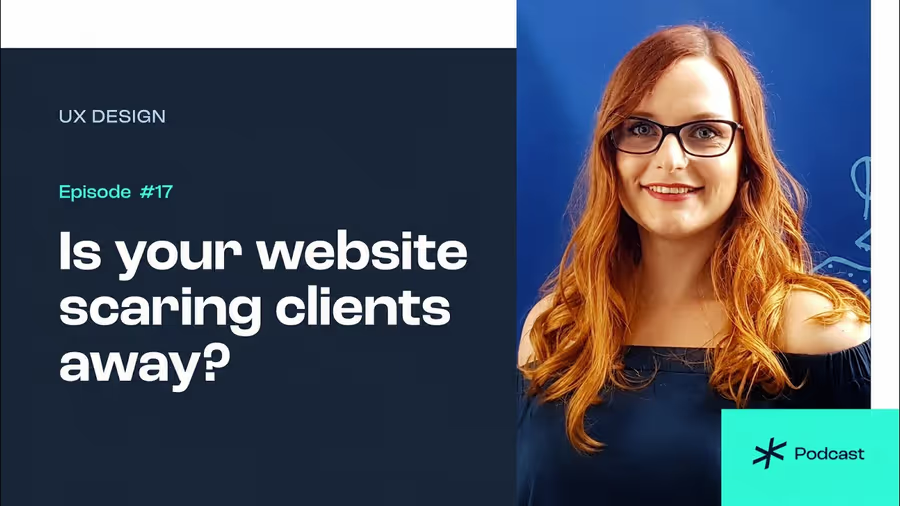
In the seventeenth episode of the CMS Conf Podcast, Katarzyna Janoska, UI developer, UX designer, and self-described WordPress unicorn with fifteen years in the industry, is asked which layer of a typical project takes most of her attention: the code, the interface, or the translation between business requirements and what gets built. Her answer is none of them. The longest phase is strategy: getting from the client what the website is for, whether that goal lines up with the goal of the business, and which part of the site carries which job. The technical layer she treats as largely solved. WordPress is old, well structured, and well established, and the community saying holds up in practice: there is a plugin for that. Custom development rarely dominates the budget, and design follows the message instead of leading it.
Kasia builds and maintains WordPress websites for small businesses, and her maintenance service covers more than updates and security: small change requests routinely turn into messaging and strategy improvements. If your site gets visitors who never become inquiries, reach out to her through LinkedIn or her profile on the CMS Conf speakers page and check what she would change first. She works through evolution rather than expensive rebuilds, so the entry cost is lower than you expect.
A Fast Website That Sells Nothing
Clients often arrive with the diagnosis already made. Google PageSpeed Insights says the site is slow, so slowness must be why there are no customers: the ranking suffers, visitors lose patience. Kasia checks the statistics first, and they usually show that visitors do arrive. Then she reads the copy, and it says some version of the same thing every time: we have the best service, you can trust us, it is fast, reliable, and conveniently delivered. Which service is that? Every service in the world.
Her test is three seconds. Not three seconds to load, although the slowness still needs fixing, but three seconds after the page appears for the visitor to know what the service is and whether it is for them. A site that fails that test loses the visitor regardless of its performance score, and she suspects the performance obsession spreads because slowness is measurable and messaging is not. A red number in a report is easier to worry about than a paragraph that could describe anyone.
The Placeholder That Never Gets Fixed
Asked which ingredient projects most often skip, flexible structure, clear messaging, or a plan, Kasia points at something earlier than all three: the input. Designers and developers she talks to get the photos from the latest photo shoot without much trouble. What they do not get is who the client’s customer is, what the main service is, and what the business does better than its competition. Without a discovery process that digs into the client’s own business, texts written about this client for this client’s customers cannot exist.
She has a theory about where the interchangeable copy comes from. Agencies on strict release schedules cannot wait a month for materials, so contracts include a clause: if the content does not arrive within seven days, a placeholder goes in. It looks professional, the client promises to replace it later, and later never comes. The generic “we are the best, fast delivery” page is a placeholder that shipped.
The same input problem shows up as a missing face. Many of her clients are one-person businesses whose entire advantage is direct contact with a specialist, and yet the website shows no trace of that person. No photo, because there was no time for a photographer. No testimonials, because the client imagines a reference needs a stamp and a signature, like in the old days. Two sentences from a real customer about why they chose you would do the work, and it stays uncollected.
Reassurance, on Every Subpage
Asked for the structural element that moves a visitor from browsing to a purchase decision, Kasia gives the expected part of the answer first: well-designed call-to-action sections, especially on content pages. A blog that ranks well and teaches well can still end every article in a dead stop, with nothing to do next except leave. Her sharper observation is about what surrounds the call to action. A footer dated 2015, an empty comment form, no links to social media, no sign anyone answers: to a visitor this reads as a graveyard website, a company that may no longer exist. That suspicion has grown teeth now that fake storefronts and AI-generated sites sell products that were never real.
So her one-word answer for what converts is reassurance. Dozens of small signals, preferably on every subpage, that the business exists, still operates, and has something concrete to buy behind the free knowledge. The host adds a case from her own circle: a friend ran a well-read expert blog with no product or service attached, and readers took the education to her competitors, who did have something to sell.
The benchmark, Kasia argues, is social media, because that is where visitors spend most of their time. One click to comment, one click to message, and the interface confirms every step: delivered, read, someone is typing. Websites offer nothing comparable, and the minimum response is making sure the basics work: the phone number connects, the mailbox gets answered, and above all the contact form actually delivers mail, which she names as the thing most often broken. She recalls a company that won a client for the sole reason that it was the only one of five whose contact form worked.
Effort in the Wrong Places
Kasia used to run a six-month online course teaching small business owners to build their own sites, and the recurring obstacle was not hosting or plugins. Participants spent a month choosing a domain name for a build that takes roughly three days once the texts exist. She files this with a wider pattern of effort spent on decisions that are either reversible or unimportant: the perfect camera bought before the first video, the drawer of expensive equipment used once.
The costliest version of the pattern is building the platform before the business. Founders assume a launched shop brings customers the way a shelf brings shoppers, and it does not; nobody stumbles onto a new website by accident, and traffic has to be pulled in deliberately. Her advice to people starting out is to validate first, on social media or free platforms, and spend on the website once there are customers to convert. One of the host’s clients built a digital product, promoted it nowhere, and was surprised nobody bought it.
One Check to Run This Week
For anyone who wants a single improvement without hiring a developer, Kasia offers a test. Open your homepage and read only the headers. If those headers could sit unchanged on a business in a different industry, selling cars instead of flowers, the messaging has failed, because the headers are the part visitors actually scan. Rewriting them is possible in any CMS and takes an afternoon, not a project.
Her talk at CMS Conf 2026 continues where the episode ends. She maintains websites built by other agencies and often gets chosen over four or five competitors, so she asks why, and she has spent three years collecting what clients complain about, including complaints about genuinely professional companies doing solid work. The talk turns that collection into case studies: what makes clients quietly leave, and the small corrections that stop it.
You can watch the full conversation above, but the case studies get their premiere on stage in Gdynia this November, and hearing the complaint list before your own clients recite it is the cheapest audit you will ever get. CMS Conf 2026 puts practitioners like Kasia in one place for two days of talks, workshops, and the corridor conversations where the real specifics change hands. Buy your ticket now at cmsconf.com, before early bird pricing ends, and join us in Gdynia.
Tags
Keep Reading

Or maybe a warm-up before Gdynia? Join us at CMS Conf Local in Vilnius
Before we meet at the main CMS Conf 2026 in Gdynia on November 12–14, we’ll see you on October 24 at CMS Conf Local: Vilnius.
Most AI Tools Won't Survive
Damian Ślimak on twenty years of automation before it had a name, why clients never ask whether AI is involved, and the one skill still worth training.
SEO After the CMS Absorbed the Technical Layer
Aleksandra Kołodziejska of Top Online on GEO, the 90/10 content split, and why real experience became the strongest ranking signal for local business sites.